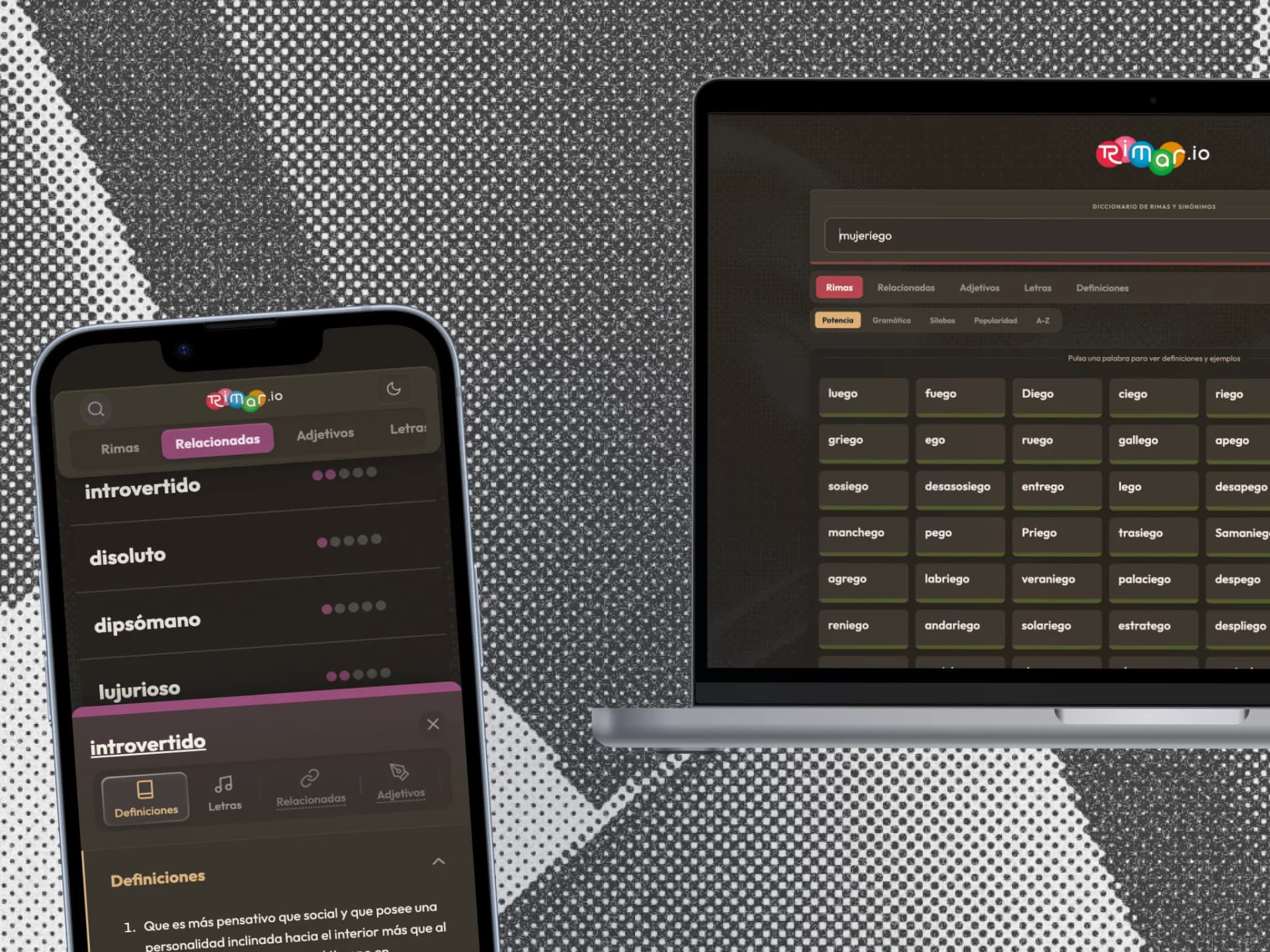
Rimario
Designing an expressive, culturally grounded reference tool for the Spanish language
Overview
A Spanish rhyming dictionary that breaks from the minimalist monoculture of modern reference sites, drawing on bold colors, tiled patterns, and organic shapes inspired by Mexican and Latin American visual traditions to create an interface that feels familiar, usable, and culturally expressive.
Technologies
Context & Motivation
Reference sites tend to be pragmatic, which over time has desaturated the once playful internet into a boring, minimalist monoculture. For Rimario, I had the opportunity to be more expressive — designing something that feels familiar and usable while visually grounded in the cultures behind the language.
That direction led me toward bold colors and patterns, such as tiles and repeating motifs, balanced with editorial and academic layouts for structure and clarity. I was particularly drawn to the work of Javier Senosiain, whose blend of organic shapes, natural tones, and bright colors feels both ancient and futuristic, giving it a sense of being outside of time.
As a Mexican American, I drew from my own experiences and spoke with family members, teachers in dual immersion schools, and second and third generation individuals working to improve their language skills and reconnect with their culture. These conversations grounded the work, and the design constraints — which focused on performance, mobile usability, and the potential for supporting artist-made backgrounds — shaped how I tested and refined the concepts.
Design Goals
Create an interface that feels expressive without becoming noisy, and information-dense yet still friendly. This led to a restrained, earthy base palette so color and texture could be used intentionally.
Use tiled elements and repeating motifs to create structure and visual separation, drawing from the rich tradition of pattern and tilework in Mexican and Latin American visual culture.
Design Constraints
Performance and mobile usability were primary constraints, ensuring the expressive visual language never compromised the core utility of a fast, accessible reference tool.
The design needed to support artist-made backgrounds, requiring a flexible visual system that could accommodate varied artwork while maintaining readability and consistency.
Process: Iterative In-Code Prototyping
Rather than working from static mockups, I used an iterative in-code prototyping process — designing directly in the browser to test how colors, patterns, and layouts felt in real use. This approach allowed me to quickly evaluate how the bold visual language held up across screen sizes and interaction states, catching issues that would have been invisible in static comps.
I have always been interested in playful, slightly whimsical interfaces that make the digital world feel more tangible. Design is always evolving, and I hope I was able to bring some of that sense of joy into Rimario.